Notice: This page is maintained personally by Nathan Simpson and does not constitute an official statement or position of Appomattox County or AVAIO Digital. The information presented is for public reference.
Everything I Know About the Appomattox Data Center and Why I Think It's a Good Idea
This page provides information about the Data Center project in Appomattox County, including historical context, impact assessments, and information about utilities and environmental considerations.
Author's Note
January 23, 2026
Since 2023, I have been involved in the effort to bring the data center to the industrial park. I did so knowingly, deliberately, and in the belief that it is in the long-term best interest of the more than 15,000 people who live here, including my own family. I did not do so for personal gain, and I am not "on the take." I live here. My interests are structurally aligned with this place in the same way yours are: the quality of our schools, the reliability of our utilities, the stability of our tax base, and whether our children can reasonably build lives here.
It is important to understand that this project did not appear out of thin air, nor was it the product of a sudden or secret decision. The land in question has been zoned for industrial use since 1999. That zoning framework was reaffirmed by the thirteen subsequent Board of Supervisors elections, by nature of the voters electing representatives responsible for appointing the Economic Development Authority, the Planning Commission, and for adopting comprehensive plans and zoning updates. Over more than two decades, the industrial park remained a 400-acre field generating little tax revenue, despite sustained efforts to attract manufacturing, logistics, and other traditional employers. Time and again, companies declined to locate here, citing the same structural realities: no interstate access, limited water capacity, and a small workforce.
At the same time, the County's own comprehensive plans consistently identified this site as the primary focus for commercial and industrial activity. In 2022, after public process, data centers were added as a by-right use within industrial zoning. The policy environment did not drift accidentally toward this outcome: it was explicitly created by official acts of representative government, over decades, without sustained public opposition. No voter has raised an objection to the conditions of the "Planned Industrial" zoning district at a public meeting in more than a decade.
If you feel blindsided, it is not because this was hidden. It is because local governance is slow, cumulative, and often invisible unless you choose to pay attention to it. Zoning maps, comprehensive plans, EDA actions, and Board minutes are not glamorous, but they are public, accessible, and consequential. This is how communities shape their future: through thousands of small, procedural decisions over time.
- If a County EDA owns a large industrial parcel;
- if it sits atop the largest natural gas pipeline in the lower 48 states;
- if one of the oldest and densest fiber routes to Northern Virginia runs a few feet beneath it;
- if your comprehensive plan designates that land as the county's primary industrial focus; and,
- if data centers are a by-right use,
then the question is not whether a project like this will happen, but when. Pretending otherwise is a refusal to engage with reality.
To those who genuinely believe they have been misled by "bad people in charge," I have a simple response: get involved in governance. Attend the meetings. Read the plans. Pull the old minutes. Learn the statutes. Understand the constraints. No one asked me to read half a century of geologic, water, and sewer studies. No one asked me to spend nights in meetings or months learning the mechanics of utilities, taxation, and land use. I did it because representative government demands effort from those who choose to participate in it.
You are free to disagree with this project. Reasonable people can. But disagreement is not evidence of corruption and complexity is not proof of conspiracy. In a representative system, trust is not blind. It is conditional, earned, and grounded in the fact that the people making decisions live with the consequences too.
This page exists to make the record legible. You don't have to like the outcome. But you should at least understand how we got here.
Sincerely,
Nathan A. Simpson
Public Trust
Large projects do not emerge from a single decision or a single individual. They move through existing institutions, over time, and are shaped by the people tasked with overseeing land use, utilities, financing, and long-term economic development on behalf of the public.
Prior to the December 2024 public announcement, knowledge of and engagement with this project existed across multiple layers of local government and economic development. Elected officials, appointed board members, and staff, serving both the County and the Town, were involved at various stages.
The individuals listed below represent a non-exhaustive cross-section of that institutional continuity.
Project Overview
Quick Links
- AVAIO Digital - Appomattox, Virginia Development - Official developer page for the data center project
- Cardinal News: Appomattox County strikes deal for data center (December 11, 2024) - News article covering the project announcement
- Laying a New Foundation: Data Center jobs and tax revenue (December 12, 2024) - Analysis of the economic benefits and opportunities the data center brings to Appomattox County
- Option Agreement for Purchase of Real Property (April 19, 2024) - Original signed agreement between Appomattox County Economic Development Authority and ADP Appomattox Data Hub, LLC
- Approved Site Plan and Stormwater Management Plan (December 18, 2025) - Project Hercules DEQ Streamlined Approval (DEQ SWM #: 2025-0435) obtained via FOIA from Virginia DEQ and Appomattox County
Appomattox Research Sources
All references to official acts, local news articles, and Appomattox historical data were derived from primary sources archived in the following repositories:
- APX Wiki - Most of my miscellaneous collection of Appomattox related records
- County Board of Supervisors Minutes Search (1992-2009) - Searchable archive of BOS meeting minutes
- Appomattox Archive Collection - General collection of reports, studies, news, and government documents
- The Times-Virginian Archive (1892-1984) - Browse all editions by date
- Times-Virginian Searchable Archive (1892-1984) - Full-text search of 2.2 million paragraphs from historical newspaper
- County Minutes Search (2018-2024) - Recent Appomattox County government meeting minutes
- Town Minutes Archive (1930-2025) - Browse official Town Council minutes by date, including handwritten and typewritten originals
- Town Minutes Search (2005-2025) - Town of Appomattox government meeting minutes
Project Timeline
2023
July 24, 2023 - Appomattox County EDA and AVAIO Begin Site Feasibility Analysis
Appomattox County Economic Development Authority and AVAIO began site feasibility analysis for proposed data center development.
2024
April 19, 2024 - Option Agreement Signed
Original signed agreement between Appomattox County Economic Development Authority and ADP Appomattox Data Hub, LLC for purchase of real property.
December 11, 2024 - Public Announcement
Appomattox County strikes deal for data center project, officially announced to the public.
2025
December 18, 2025 - Site Plan Approved
Project Hercules DEQ Streamlined Approval obtained (DEQ SWM #: 2025-0435) for approved site plan and stormwater management plan.
I.D.A. Park History
When was the IDA Park Purchased?
In 1998, the Appomattox County Board of Supervisors approved the Industrial Development Authority's recommendation to purchase 575 acres from G. D. Gilliam for $2,500 per acre to establish an industrial park. The purchase was financed through a $2.5 million lease revenue bond, with interest-only payments for the first five years, followed by principal and interest payments for the next 15 years. Following a public comment session in July 1998, citizen responses to the proposed industrial site were reported as favorable. The purchase included a provision that 100 acres could be reserved for a recreational facility.
Click to expand to view a full history of the IDA Park from 1955 to Present.
IDA Park Timeline
1955
Transcontinental "Transco" Pipeline Construction
The Transcontinental natural gas pipeline was built, establishing key infrastructure in the area.
1997
April 17, 1997 - IDA Briefing Scheduled
The IDA was scheduled to meet and be briefed on the Board of Supervisors' expectations.
August 4, 1997 - Formation of Regional Industrial Development Authority
Board of Supervisors voted to form a Regional Industrial Development Authority with the Town of Appomattox, passing a resolution stating the Board's intention to establish this joint authority.
1998
June 22, 1998 - Joint Meeting of Board and IDA
Joint meeting of Board of Supervisors and IDA held executive session to discuss property acquisition, and Board voted to hold public comment session on July 13 and formal vote on July 20.
July 13, 1998 - Public Comment Session
IDA presented proposal for industrial park including preliminary engineering, financing, and marketing plan during joint public comment session.
July 20, 1998 - Land Purchase Approved
Board voted 4-1 to purchase 575 acres from G.D. Gilliam at $2,500 per acre, with plan for County to purchase land and then deed it to IDA.
October 1, 1998 - Industrial Development Authority Bond Dated
Industrial Development Authority of Appomattox County, Virginia Capital Improvements Lease Revenue Bonds Series 1998 dated.
October 6, 1998 - Land Purchase Appropriation
Board appropriated $1.2 million from the Capital Improvements Account to pay for the industrial park land.
1999
April 12, 1999 - Execution of Town–County–IDA Water and Sanitary Sewer Capacity Agreement
The Town of Appomattox, Appomattox County, and the Industrial Development Authority executed a binding Memorandum of Understanding allocating fixed water and wastewater treatment capacity to support development of the Appomattox Industrial/Recreation Park, permanently reserving 146,000 gallons per day of wastewater treatment capacity and 45,000 gallons per day of potable water capacity for the park.
2000
February 15, 2000 - Amendment to Water and Sewer Agreement Restructuring Plant Financing
The Town, County, and Industrial Development Authority amended the 1999 agreement to restructure financing for the wastewater treatment plant expansion, formalizing the Town's $3.203 million zero-interest loan from the Virginia Resources Authority and obligating the County to reimburse 48.67% of all debt service and prior cash expenditures.
July 10, 2000 - Public Hearing on M-2 Planned Industrial Park District Zoning
Public hearing held on creating M-2 Planned Industrial Park district zoning classification, item was tabled until August 7, 2000.
September 18, 2000 - Public Hearing on Petition #00-443
IDA petitioned to rezone the Industrial Park property from A-1 to M-2, with IDA Chairman Bill Slagle testifying that M-1 zoning didn't accommodate the park's intended purposes.
October 2, 2000 - Board Approved Rezoning to M-2
Planning Commission recommended approval and Board approved petition #00-443, officially rezoning the industrial park from A-1 (Agricultural) to M-2 (Planned Industrial Park District).
2001
December 3, 2001 - Zoning Designation Changed from M-2 to M-IP
Board approved IDA's request to change zoning designation from "M-2" to "M-IP" (Planned Industrial Park District) to avoid confusion with heavy industrial districts, no public hearing required.
2005
Fiber Optic Network Connection
Appomattox designated as a major connection station for MBC's 700-mile fiber optic network, linking to Northern Virginia with a Point of Presence utilizing the National Lambda Rail fiber backbone.
2006
Industrial Development Authority renamed to Economic Development Authority
The Industrial Development Authority was formally renamed as the Economic Development Authority through amendments to the Appomattox County code.
2009
May 5, 2009 - Amendment Allowing Commercial Sewer Use Along Route 460
The Town, County, and Economic Development Authority amended the original agreement to allow sanitary sewer service to undeveloped commercial property along Route 460 within the Town boundary while explicitly preserving the Industrial Park's reserved 146,000 gallons per day of wastewater treatment capacity.
July 7, 2009 - Comprehensive Zoning Ordinance Revision Presented
Planner Johnnie Roark presented a comprehensive zoning ordinance revision implementing the 2003 Comprehensive Plan, splitting the Industrial District into three zones including I-1 (Low Intensity Industrial) for R&D, warehousing, and data centers, and redesignating M-IP to I-3 (Planned Industrial Park).
2011
January 1, 2011 - Execution of Long-Term Regional Water Supply Contract with Campbell County
Appomattox County entered into a twenty-year water purchase contract with the Campbell County Utilities and Service Authority, securing a regional wholesale potable water supply of up to 250,000 gallons per day.
2012
February 23, 2012 - Execution of Water Line Operations and Maintenance Agreement
Appomattox County and the Town of Appomattox executed a comprehensive water line maintenance and operations agreement assigning day-to-day operation, regulatory compliance, billing administration, emergency response, and enforcement authority for the County's Route 460 waterworks to the Town.
2019
December 3, 2019 - Lease and Conditional Transfer of County Water Facilities to the Town
Appomattox County and the Town of Appomattox executed a lease and sale/purchase agreement transferring full operational control of County-owned water infrastructure, terminating and replacing the 2012 maintenance agreement and establishing the legal pathway for consolidation of the County water system into Town ownership.
2022
October 17, 2022 - Data Center Definition Approved
Board of Supervisors voted 5-0 to approve a definition of "data center" as industrial manufacturing structures, establishing them as a by-right use on industrial zoned properties under the zoning ordinance.
Economic Development Authority
What is the Appomattox County Economic Development Authority?
The Appomattox County Board of Supervisors established the county's Industrial Development Authority in the 1970s. It was renamed as the Economic Development Authority in 2005.
The EDA is chartered pursuant to a state law that allows cities and counties to form bodies with wide-ranging powers not available to municipal governments. These functions must facilitate economic development opportunities within their boundaries:
- It can buy, sell and develop land for use as economic development or public facility sites.
- It can build commercial facilities to be sold or leased to private companies.
- It can issue revenue bonds either to finance county infrastructure improvements or provide financing for private companies.
- It can provide financial incentives to attract new companies to Appomattox or induce existing businesses to expand.
Each of the seven members of the EDA board are appointed by and act at the direction of the Board of Supervisors. Members are appointed for four years, with staggered terms that allow for ongoing continuity on the board. They are often chosen from the local business and professional community.
Current Members
- Garet Bosiger, Chairman - Term expires: December 31, 2027
- Gary W Tanner, Vice-Chairman - Term expires: December 31, 2029
- Don Jones - Term expires: December 31, 2027
- Todd Nash - Term expires: December 31, 2028
- Patrick Richardson - Term expires: December 31, 2026
- Jeff Smith - Term expires: December 31, 2028
Utilities
Electricity
Do data centers raise the price of electricity?
Yes.
Will this data center raise electricity costs for people in Appomattox County more than in counties without data centers?
No.
Why not?
Electricity rates are set across each utility's entire service territory and approved by the Virginia State Corporation Commission. Appomattox customers served by Dominion, CVEC, and SEC pay the same rates as other customers of the same class served by those utilities elsewhere in Virginia.
Ensuring that large electricity users pay an appropriate share of generation and transmission costs is a matter of state-level policy. That responsibility rests with the General Assembly and the State Corporation Commission, not with individual counties.
At the state level, there is an active policy conversation around improvements such as creating a distinct data-center customer class, refining cost-allocation rules, and adjusting rates more dynamically. Measures like these could help better insulate residential and small-business customers from statewide cost increases driven by large new loads.
The Bigger Picture
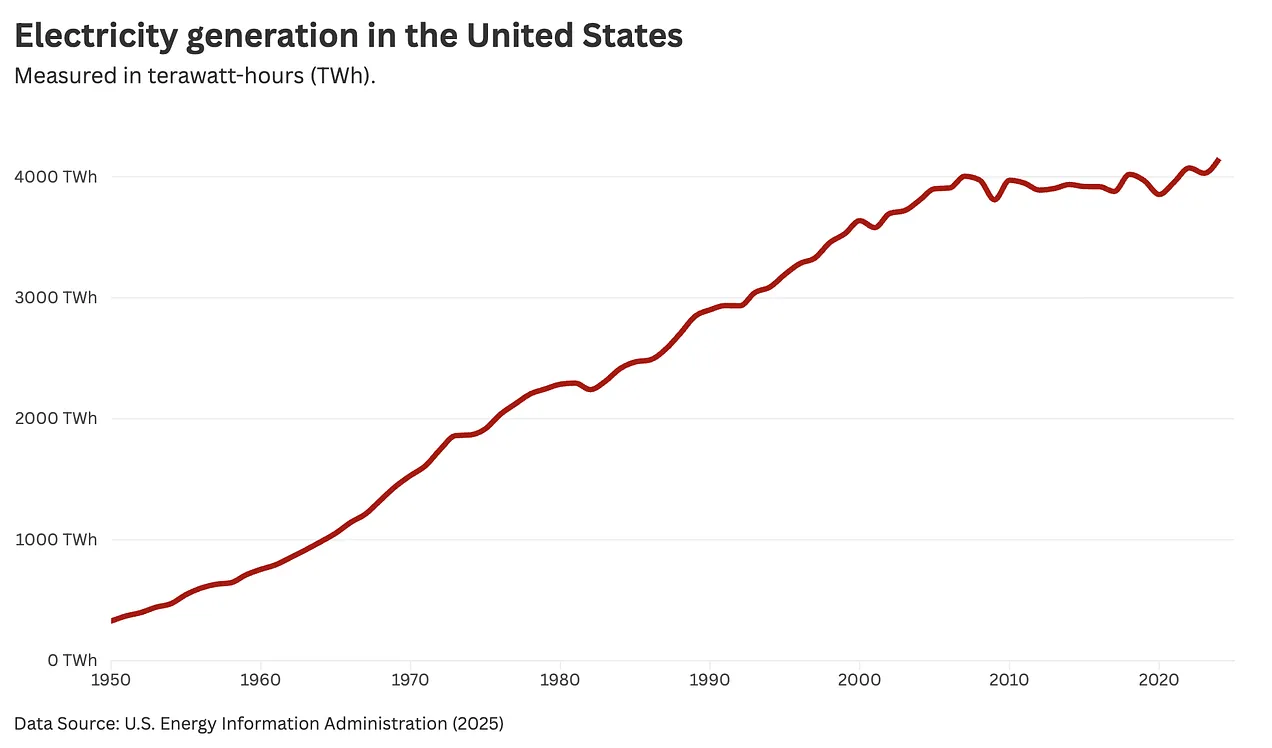
For the last three decades, the United States added relatively little new electric generation because overall demand was flat. That has changed quickly. Data centers—and, to a lesser extent, the electrification of heating that once relied on propane, fuel oil, or natural gas—have created a sharp increase in electricity demand.
At the same time, generation costs are rising. Renewable sources such as solar and wind have expanded rapidly with federal support, but they require large-scale battery systems to be reliable.
A Unique Win for Appomattox
Many of the power-reliability issues residents experience today are not driven by new demand, but by aging infrastructure. Appomattox has not historically been a high-growth electricity market, which meant major upgrades to substations and transmission lines were deferred for decades.
This project changes that trajectory. The data center accelerated roughly $100 million in new substation and transmission investments that were previously not expected until sometime before 2050. Those upgrades improve reliability for everyone.
A Note on Solar
Solar plays a role in the energy mix, but it is not a standalone solution for round-the-clock reliability. In practical terms, it functions more like a supplemental system than a primary one—useful, visible, and valuable in certain conditions, but dependent on other infrastructure to carry the full load. Reliable power still comes from the broader grid, backed by firm generation and transmission capacity that keeps the lights on regardless of weather or time of day.
Water
How much water will the data center use?
Each building will use an average of 3,000 gallons per day. Once fully built out, the entire campus will use an average of 36,000 gallons per day. Water usage is capped contractually at a maximum of 45,000 gallons per day by existing contracts between the Town of Appomattox and the Appomattox County EDA. Any additional municipal water capacity must be approved by the Town Council.
I thought data centers used millions of gallons of water per day?
Some do when they use evaporative cooling systems. This site will use closed-loop cooling which recirculates water as opposed to evaporating it in "wet" cooling towers.
Traditional towers rely on continuous water evaporation, leading to high water consumption and the need for chemical treatment, which increases operational costs. These systems also require frequent maintenance to manage scaling, corrosion, and biological growth.
Don't closed loop systems use harmful chemicals?
If your definition of harmful is "don't drink that," then sure. It's typically a water + glycol mixture, aka antifreeze.
Water Usage: Data Center Campus vs Car Wash
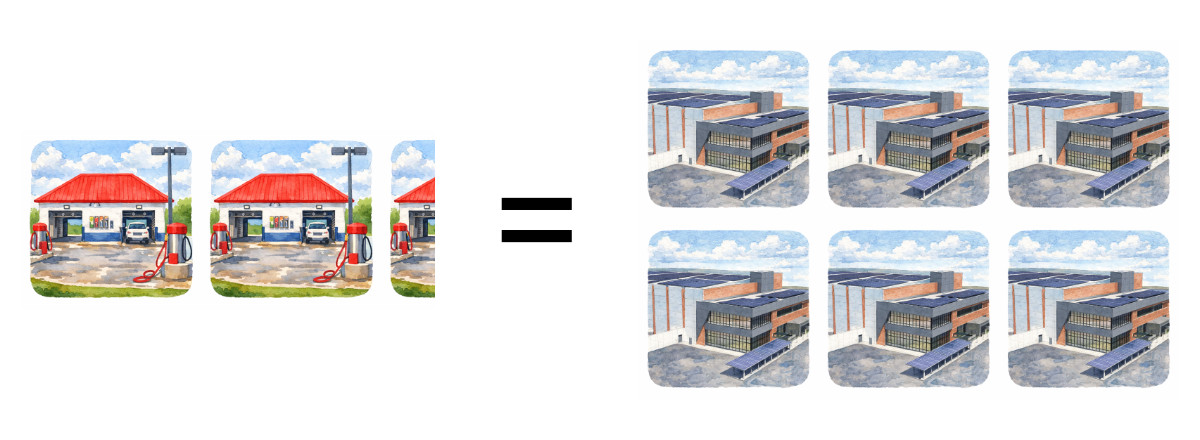
To put the data center's water usage in local context, the entire 6-building campus will use approximately 18,000 gallons per day. This is roughly equivalent to 2.5 times the water consumption of the Automatic Car Wash. The facility's water demands are modest and comparable to existing commercial operations already served by the Town water system and 460 Pipeline.
| USER | GPD |
|---|---|
| AUTOMATIC CAR WASH | 8,000 |
| DATA CENTER (ONE BUILDING) | 3,000 |
| DATA CENTER (ENTIRE CAMPUS – 6 BUILDINGS) | 18,000 |
| IDA PARK COMMITTED CAPACITY | 45,000 |
| TOTAL TOWN + COUNTY SYSTEM CAPACITY | 250,000 |
Water - Wells
What if they try to drill a bunch of wells, won't they run the Town dry?
This is geologically improbable and already handled by County Code and Contractual Provision.
As a matter of County Code, any building connected to the County waterworks is prohibited from using an alternative source of water except for "minor or incidental use of bottled water or cistern-collected water."
Additionally the 1999 MOU sets the precedent that the Town would have the right to develop wells on the site to supplement its system.
Natural Gas
On-Site Power Generation
This page is intentionally focused on the data center project itself—its land use, utilities, environmental impacts, and fiscal effects. It does not evaluate permanent natural gas gigawatt scale generation.
A utility-scale natural gas generating facility (on the order of hundreds of megawatts) is a fundamentally different class of project than a data center. Such facilities involve multi-year federal and state permitting processes, transmission planning, and environmental and air quality permitting. Those decisions are driven primarily by state and federal energy policy and utility system needs, not by the preferences or actions of any single county.
For context on the complexity and duration of approving new natural gas generation, see Dominion Energy's ongoing efforts to permit new generation in Chesterfield County. These projects involve years of regulatory review and do not "spring up" quickly or quietly.
Any proposal for permanent on-site generation would require its own independent review, public process, and regulatory approvals, entirely separate from the data center project described here.
Land Use & Planning
The industrial park is the only land in the entire county zoned for industrial use.
Community Benefits
Tax Revenue
The data center project represents a significant source of tax revenue for Appomattox County. This revenue will support local services, infrastructure improvements, and ultimately, a reduction in resident tax burden. The project's substantial capital investment translates into ongoing annual tax contributions to the county's budget.
Illustrative Direct Tax Impact of a Data Center
This analysis shows three illustrative scenarios (low, median, high) using fixed tax rates and simple statutory equations. All values are annual and rounded for clarity.
Inputs
| Input | Value |
|---|---|
| Real Estate Tax Rate | $0.63 per $100 assessed value |
| Machinery & Tools Tax Rate | $1.00 per $100 assessed value |
| M&T Assessment Basis | 80% of initial equipment cost |
| Current Local Revenue (FY23) | $20,000,000 |
| Current Federal & State Revenue (FY23) | $32,000,000 |
| Total County Budget (FY23) | $52,000,000 |
Equations
| Description | Equation |
|---|---|
| Real Estate Tax | (Real Estate ÷ 100) × 0.63 |
| Taxable Equipment Value | Initial Equipment Cost × 0.80 |
| Machinery & Tools Tax | (Taxable Equipment ÷ 100) × 1.00 |
| Total Annual Revenue | Real Estate Tax + M&T Tax |
Scenario Results
| Scenario | Taxable Real Estate | Initial Equipment Cost | Real Estate Tax | M&T Tax | Total Annual Revenue |
|---|
Visual Comparison
Reference lines show current locally generated revenue ($20M) and the total County budget ($52M).
County Revenue Impact
Shows current county revenue compared to total county revenue with data center contributions added.
Jobs
The data center will create employment opportunities for local residents during both the construction and operational phases. Construction will provide temporary jobs in various trades, while ongoing operations will require skilled technical staff for facility management, maintenance, security, and administration. These positions offer competitive wages and benefits that contribute to the local economy.
| Phase | Estimated Jobs | Duration | Job Types |
|---|---|---|---|
| Construction Phase | 1000+ | Temporary (during build-out) | General contractors, electricians, plumbers, HVAC specialists, equipment installers, site workers |
| Operations Phase | ~200 | Permanent | Facility managers, data center technicians, network engineers, maintenance staff, security personnel, administrative support |
It's also worth being honest about something that gets lost in these conversations: not every person employed at a facility like this will already live in Appomattox, and no serious person should expect that. That's how major employers have always worked here. The Thomasville plant brought in people from outside the county too, and at the same time it anchored hundreds of families who did live here. A data center is no different. Some specialized roles will be filled regionally or nationally, especially early on. But a meaningful share of the permanent, full-time jobs—security, facilities, mechanical and cooling systems, grounds and maintenance—will be filled by people who live locally. And the most basic truth still applies: two hundred steady jobs is not a theoretical exercise. It's two hundred more paychecks than an empty field produces.
What this Means for Appomattox
For decades, Appomattox County has faced a familiar constraint: our needs have grown faster than our locally generated revenue. Schools age, utilities require expansion, healthcare access lags, and recreational and workforce facilities compete for limited capital. These challenges are the predictable outcome of a small tax base spread across a large rural geography.
The significance of the data center project is not simply that it brings jobs or that it occupies land in the industrial park. Its importance lies in scale, reliability, and durability of revenue, three characteristics that are rare in rural economic development and difficult to achieve through incremental growth alone.
Unlike residential development, which increases service demands faster than it generates tax revenue, or light commercial growth, which often produces modest returns, a data center concentrates substantial capital investment on a fixed footprint. That investment produces recurring local tax revenue without a proportional increase in demand for schools, emergency services, or public assistance. In practical terms, it creates fiscal capacity and room in the budget to do things that have long been discussed but repeatedly deferred.
That capacity changes what is possible.
It allows the County to contemplate projects that would otherwise require state grants, federal intervention, or decades of debt service. It strengthens the County's ability to match state and federal grant funding when it is available, rather than watching opportunities pass by for lack of local contribution. It provides stability against economic cycles that disproportionately affect small communities reliant on a narrow mix of employers.
The projects outlined below are not abstract promises or wish lists. They represent long-standing needs that have been identified in planning documents, capital improvement discussions, and public meetings for years. Missing has been a sustainable revenue source capable of supporting them without shifting additional burden onto residents.
This project provides that missing piece.
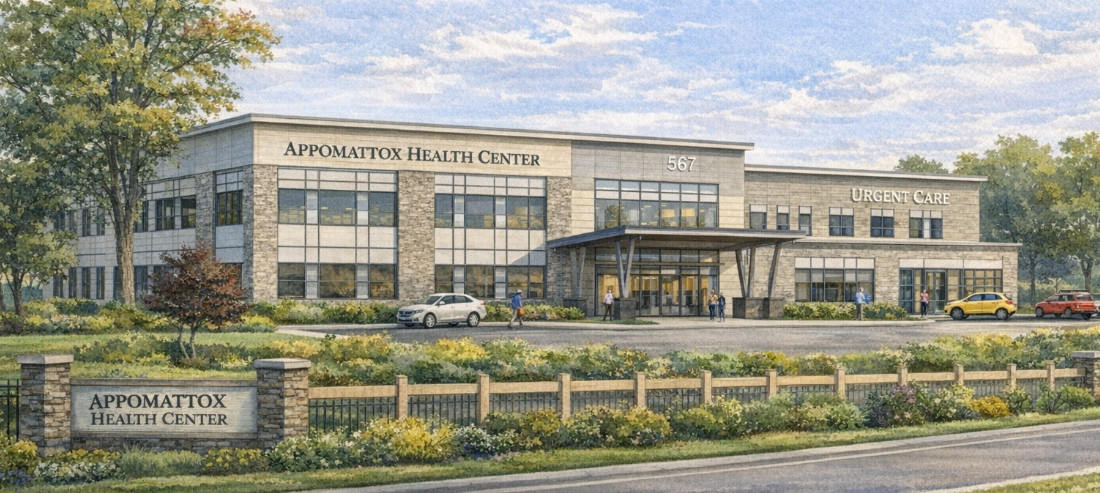
Improve access to Healthcare by Building a Multi-provider Medical Center via Public-Private Partnership
Estimated Cost: $10 million

Strengthen Water and Sewer Infrastructure and extend utilities to neighborhoods currently experiencing well contamination from nearby septic drain fields.
Estimated Cost: $20 million
Extend public water and sewer services to areas where private wells have been compromised by failing septic systems, improving public health and quality of life for affected residents.
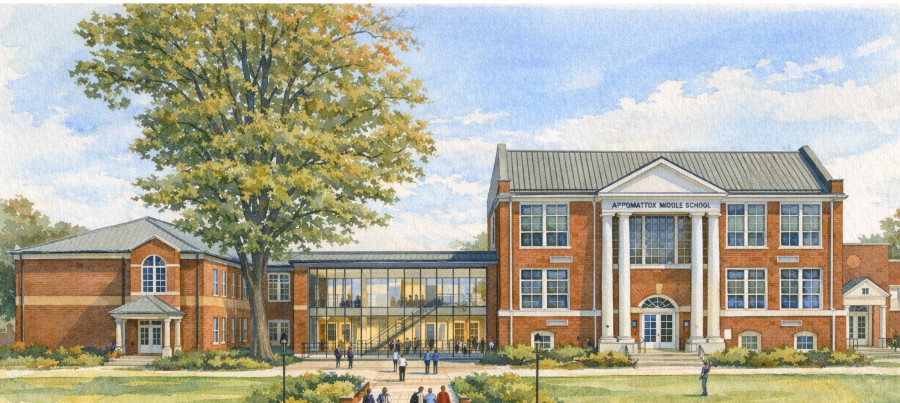
Renovate and Expand Appomattox Middle School
Estimated Cost: $20 million

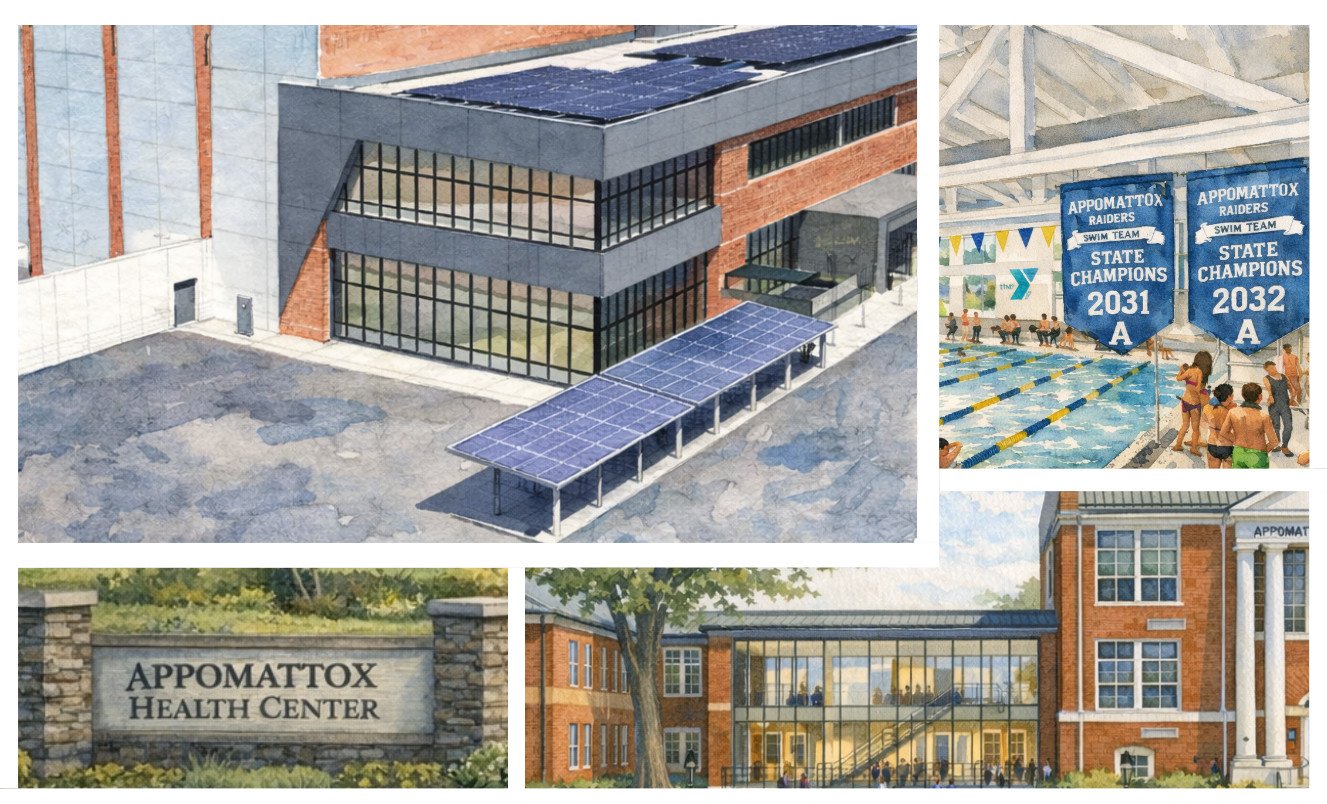
Build a Community Recreation and Aquatic Center
Estimated Cost: $25 million

Expand Vocational and Workforce Training at the Carver-Price CTE Center
Estimated Cost: $10 million
Impacts & Environment
Air Pollution
Under normal operating conditions, a modern data center with closed-loop cooling produces no significant on-site air pollution. Its only direct air emissions come from the strictly regulated and intermittent use of its backup generators.
From a regulatory perspective: The facility is a permitted source of air pollution precisely because of the generators. It has a permit to pollute, albeit under very strict and limited conditions.
Specific Pollutants
Airborne particulates (PM 2.5 / 10), Nitrogen Oxide (NOx), Ozone precursors, and Sulfur Dioxide SO2 emissions from data centers are caused by the combustion of fuel in backup generators. Standby or "emergency" generators are subject to Tier 2 EPA emission requirements. Standby generators only run during power failures and regular site maintenance testing.
Noise
Noise is a legitimate impact on nearby residents and should be evaluated and managed, not dismissed as an unmeasurable nuisance.
Sources of Noise
Data centers do not produce meaningful noise from the computing equipment itself. The primary sources of sound at this site are associated with supporting infrastructure, including:
- Cooling equipment such as air-cooled chillers and their associated fans.
- Electrical infrastructure, including transformers and uninterruptible power supply systems.
- Backup generators, which operate only during rare, short-duration, and tightly regulated events outside of normal grid conditions.
All of these sources are fixed in location, operate within known parameters, and produce predictable sound levels. Their acoustic characteristics are well documented and routinely modeled in advance, allowing potential impacts to be anticipated, measured, and controlled.
Low-Frequency Mechanical Sound
Low-frequency sound is a common part of everyday life and originates from familiar sources such as wind, distant traffic, HVAC systems, agricultural equipment, and large mechanical fans. At a data center, this type of sound comes primarily from cooling equipment and electrical infrastructure not from the servers themselves.
This sound is typically not sharp or intermittent, but a steady background "hum" that can be more noticeable at night when ambient conditions are quieter. Perception depends less on the size of the equipment and more on distance, terrain, atmospheric conditions, and operational settings.
Operational controls, including reduced fan speeds during nighttime hours and continuous sound monitoring, are used to ensure noise levels remain below thresholds most people can hear or find disruptive.